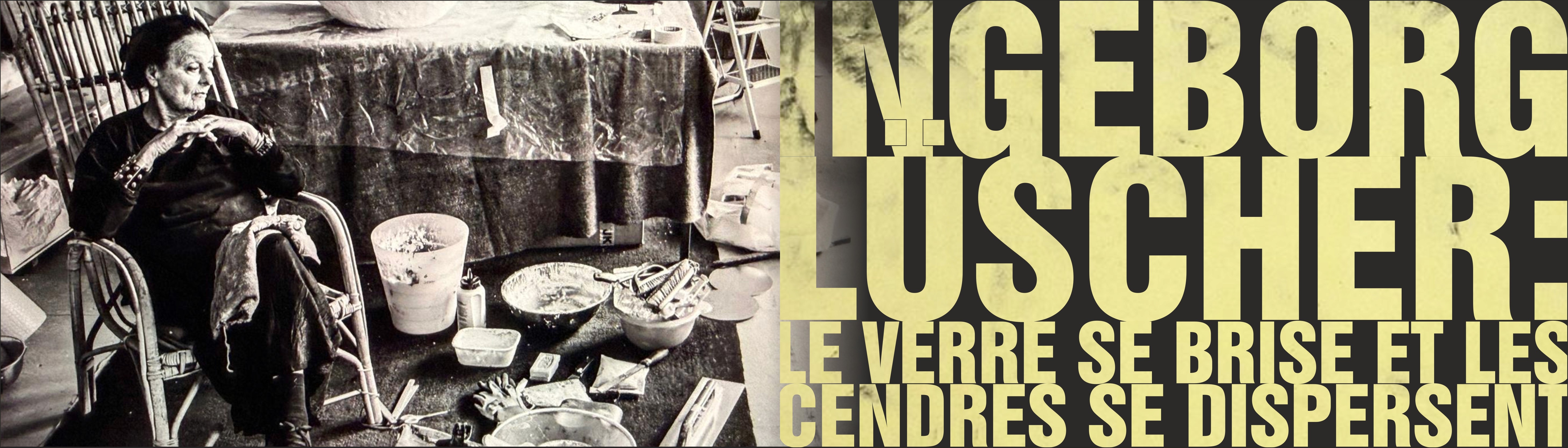
INGEBORG LÜSCHER: The glass shatters and ash scatters “The glass shatters and ash scatters” can today, rightly, be read as a metaphor for the work of the German-Swiss artist Ingeborg Lüscher (*22 June 1936), currently on view in the eponymous solo exhibition at Galerie Bastian in Paris. At the same time, the exhibition title opens a view onto her life—or life in general. Glass as a metaphor for fragility; scattered ash as a symbol of what has burned and passed; and with it a gesture toward farewell, finality, and mourning. The title chosen by the artist reads more like a literary quotation or a scene from a poetic work. And yet, since this is about the artist’s oeuvre, one could hardly describe the present moment of her late life more aptly: an illusion is destroyed in an image, or a memory is released—like ash freed from a fragile container by shattering glass.
An analogy for a life spanning almost 90 years, and at the same time an ode to life. Born in Saxony, Ingeborg Lüscher lives and works in a valley surrounded by mountains in Ticino. After an early career in acting and film, she turned to visual art at the end of the 1960s. As the exhibition at Galerie Bastian shows—with around 40 works in a retrospective from 1968 through the 2010s in the Marais—Lüscher’s artistic practice, situated in the field of tension between autobiography and alchemy, is a constant search for new forms of expression and thus for different material vocabularies. It is discarded objects or remnants—much as with the artists Joseph Beuys and Daniel Spoerri, with whom she maintained long friendships—that interest Lüscher as traces of lived life, and to which she grants a new identity as artworks.
Alongside sculptures, photographs, paintings, and installations, the exhibition offers viewers a comprehensive look at more than 50 years of her work, shaped by influences ranging from Fluxus and the Nouveaux Réalistes to Arte Povera. In 1968, it was first her wall-object boxes—“Inboxen”—with an appearance ranging from red to blue and a sooty surface, in which Lüscher transformed the material polystyrene with a blowtorch, as if in an alchemical process, in order to make processes of change visible. Entirely in the spirit of Bertolt Brecht’s ballad: “Yes, make a plan! Be a bright light! And then make a second plan. Neither of them will work.” And so she continued her work in the series of cigarette pictures and objects—such as a chair with shoes on a pedestal here in the cabinet room in the basement—with the so-called “Verstummelungen.”
Drawing on burnt cigarette butts as residues and relics of her smoking, and in the analogy of tobacco-filled “coffin nails,” she saw in them “an image of smoked time as lived life.” As a consequence, her fire performance of 1971—currently honored in depth in her solo exhibition Flammes (26 March to 26 July 2026) at the Centre Culturel Suisse (CCS) in Paris—was only consistent. Wearing a fire-protection suit, she ignited a styrofoam column to music by Karlheinz Stockhausen and once again made clear that transformation is the essential axiom of her works: because they relate to becoming out of passing away, and take form through material changes unfolding in time and space, in order to be able to radiate spiritual energy.
But the aspect of ash as the result of inner glow—immediately linked to the unsteady, blazing element of fire—also interested the artist throughout her life. And so, from the early 1980s onward, ash became for Lüscher a pictorial metaphor for darkness as an expression of inner retreat, but also a way to give corporeality to black—paired with pale yellow sulfur as a guiding image of light. The complement first developed through luminous, sulfur-soaked boxes, encountered by viewers gathered on a table upon entering the gallery, and later led to the large canvas formats shown in the basement, in which ash and sulfur schematically interpenetrate one another in large panels as opposites—comparable to central themes such as birth or love and death, or visibility and invisibility.
Minimalist abstract art, conceptually prepared, yet beyond the real. And still a compelling interplay. Long before she began painting in the early 1980s, Ingeborg Lüscher’s fascination with the human image led her—among other works, the three large-format drip paintings on packing paper—to photography. In 1975 she produced photographic series of her daughter Una; in her work “re ~” (1979/80) she photographed her own reflection and, with various head coverings, transported herself into a past era. She selected a dozen of the solarized shots; in the exhibition they are mounted in a circle on a large wall opposite the entrance, with the contemporary likeness—an allusion to reincarnation—hanging above the other portraits.
Another photographic series on display shows patches of skin spreading out like abstract landscapes, speaking of the artist’s human depths; likewise the “Flying Waters” of her series “Die Quelle” (1995) show urine streams wavering through the air as traces of existence and can be read as incubators of new life; or Das Heim der Krebse (1998), a series of 46 photographs in which Lüscher traces the energy currents of animals. After the magician photographs most recently shown at Galerie Bastian Paris (from 1976 to today)—an attempt at an overall portrait through more than 500 portraits, mostly of significant figures from the art and cultural world such as Andy Warhol, Ai Weiwei, Lawrence Weiner, James Lee Byars, or Richard Serra—the current exhibition illuminates all phases of the artist’s work.
In addition to a second solo exhibition at CCS Paris, Ingeborg Lüscher is currently also represented in the institutional group exhibition FORBIDDEN COLOURS at FORMA (April to June 2026) in Paris with key works such as a multi-part large sculpture and a large-format triptych, in dialogue with works by, among others, Heidi Bucher, Carlotta Ikeda, On Kawara, Yves Klein, Ana Mendieta, Fausto Melotti, and Nicolas de Staël. The glass shatters and ash scatters—an exhibition like a legacy, curated by Sebastian C. Strenger.
Exhibition Dates
15.04.2026 - 17.06.2026
Exhibition Views
Exhibition Views