Dan Flavin was an influential American artist, a pioneer of Minimalism and of the use of light as a medium. He produced a singularly coherent and prolific body of work, leaving an important and lasting legacy that changed the course of twentieth-century art.
In 1933, Daniel Nicholas Flavin Jr. was born in Queens, New York, into an Irish Catholic family. He was compelled to study for the priesthood at the Immaculate Conception preparatory seminary in Brooklyn. He later recalled: “Soon religion was forced upon me to destroy any childish optimism I might still have had”¹. He subsequently enlisted, together with his twin brother David, in the meteorological branch of the U.S. Air Force. During his military service, Flavin developed an interest in art, which he pursued through the University of Maryland extension program in Korea. After returning to New York in 1956, he continued this pursuit by attending the Hans Hofmann School of Fine Arts, studying art history at the New School for Social Research, and completing his studies at Columbia University with a course in drawing and painting.
Flavin’s early works reflect his interest in Abstract Expressionism. As early as 1959, he began assembling collages from objects found in the street, including crushed tin cans. At that time, the young artist worked as a mailroom clerk at the Guggenheim Museum, where he met artist Sol LeWitt, critic and curator Lucy Lippard, minimalist painter Robert Ryman, and art historian Sonja Severdija, whom he married two years later. In 1961, he held his first solo exhibition of collages and watercolors at Judson Gallery in New York. That summer, while working at the Museum of Natural History, Flavin began sketching sculptures made of electric light. The same year, he created his first assemblages, which he called “Icons”: eight monochrome paintings surrounded by electric light bulbs, one of which was dedicated to his recently deceased brother David. The reference to icons is emblematic of his work: an tireless conceptual exploration of space and light. “I prefer art as thought rather than as labor,” “I have always maintained this. It is important to me not to dirty my hands. This is not instinctive laziness. It is a statement: art is thought”².
From 1963 onward, Flavin worked exclusively with industrially manufactured fluorescent tubes, assembling them in different ways depending on the installation. He used only six lamp colors: red, yellow, blue, green, pink, and ultraviolet; and four whites: cool white, warm white, daylight, and soft white. His attachment to simple forms, his use of industrial materials, and the symbolic scope of his works bring his approach close to those of Donald Judd and Sol LeWitt. Throughout the 1960s, as he experimented with light, color, and space, Flavin rejected studio production and refused to describe his works as “works” or “sculptures,” preferring to call them “proposals” or “installations.” Most of his works are titled Untitled but include a dedication in parentheses, such as his famous Monuments for V. Tatlin, a tribute to the Russian painter, sculptor, and architect Vladimir Tatlin. In 1970, Flavin began issuing certificates on graph paper, including diagrams of the work, written descriptions, and his signature. His aim was to protect the works and ensure their preservation.
At the end of the 1970s, the artist initiated a collaboration with the Dia Art Foundation, which led to the realization of several permanent site-specific installations and, more recently, to the touring exhibition Dan Flavin: A Retrospective (2004–2007). Flavin then concentrated on large-scale installations specific to sites as varied as Frank Lloyd Wright’s spiral rotunda at the Guggenheim Museum and a former nineteenth-century railway station in Berlin, now converted into a museum of contemporary art (Für Gegenwart). Although the scale of his works increased, the materials, aesthetics, and thought present in his early light experiments remained intact.
The artist died in Riverhead, Long Island, New York, on 29 November 1996. At the time of his death, many planned works remained unrealized and uncertified; the Flavin estate decided not to issue works that had not been certified during his lifetime. A few installations were completed posthumously, notably the impressive Chiesa di Santa Maria Annunciata in Milan. He remains one of the most striking and innovative artists of his time, and his installations are now regarded as icons of Minimalism.
¹ Dan Flavin, “… in daylight or cool white.” an autobiographical sketch (to Frank Lloyd Wright who once advised Boston’s “city fathers” to try a dozen good funerals as urban renewal), Dan Flavin: The Complete Lights, 1961–1996, 2004, p. 189. ² Dan Flavin, interviewed by Phyllis Tuchman, Dan Flavin: A Retrospective, 2004, p. 194.
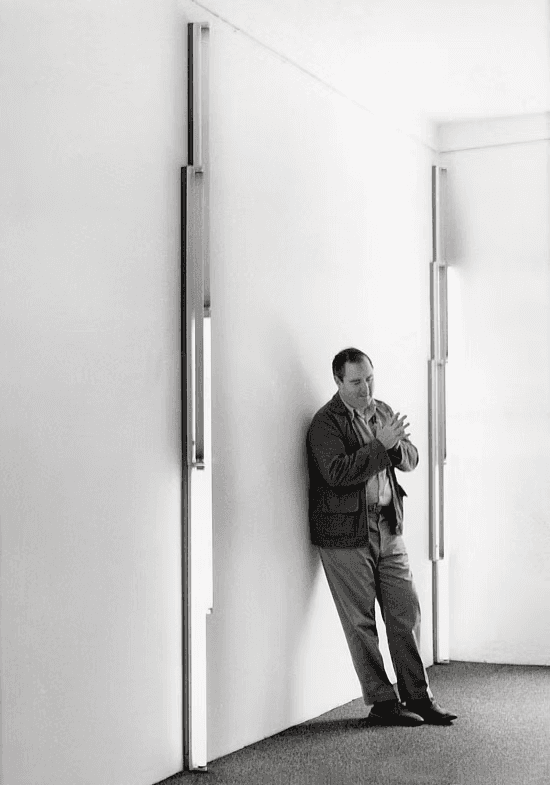
Dan Flavin