Born in 1973 in Jaén, Cristina Lucas lives and works in Madrid. From 1998 to 1998, she studied Fine Arts at the Universidad Complutense de Madrid (Spain). From 1999 to 2000, she continued her studies at the University of California, Irvine (United States), and later from 2006 to 2007 at the Rijksakademie van Beeldende Kunsten in Amsterdam (Netherlands). Since 2004, her works have been exhibited internationally. She has presented solo exhibitions at the Centro de Arte Dos de Mayo in Móstoles (near Madrid), the Museo de Arte Carrillo Gil in Mexico, the OK Centrum in Linz, MUDAM in Luxembourg, Kunsthall 3.14 in Bergen, as well as the Kunstsammlungen Chemnitz. More recently, she participated in Manifesta 12 in Palermo. She has also been invited to several contemporary art biennials, such as the 12th Shanghai Biennale and the 5th Ural Industrial Biennial. Most recently, her works were presented in the major group exhibition Diversity United, held at Tempelhof Airport in Berlin, the New Tretyakov Gallery in Moscow, and the Palais de Tokyo in Paris.
For nearly three decades, Cristina Lucas has dedicated her extensive artistic research to the consequences of the destructive exploitation of the environment and to the history of our societies. Her work seeks to question economic ideologies and contemporary technologies and connect them to a new—or rediscovered—ethics. She also explores the following question: what forms of community must we invent to face the challenges ahead? Cristina Lucas’s work is multifaceted and uses a wide variety of media: performance, photography, sculpture, installation, and painting. Her artistic credo is based on aesthetic seduction as a means of making us aware of the dynamics that shape our societies. Her works address the mechanisms of power, subtly analyze their political and economic structures, and deconstruct them in order to reveal the contradictions between official history, reality, and collective memory. She also develops new forms of cartographic representation of the world, mapping, among other things, relations of power, language, gender, and energy—often with a touch of irony. Cristina Lucas is now considered one of the most important contemporary artists in the Spanish-speaking world.
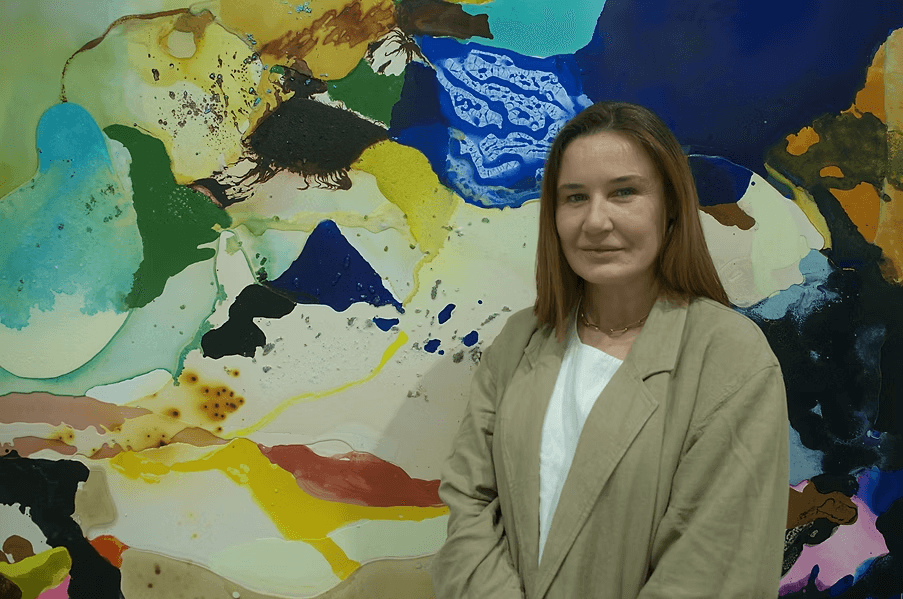
Cristina Lucas | Photographed by Jan Marot